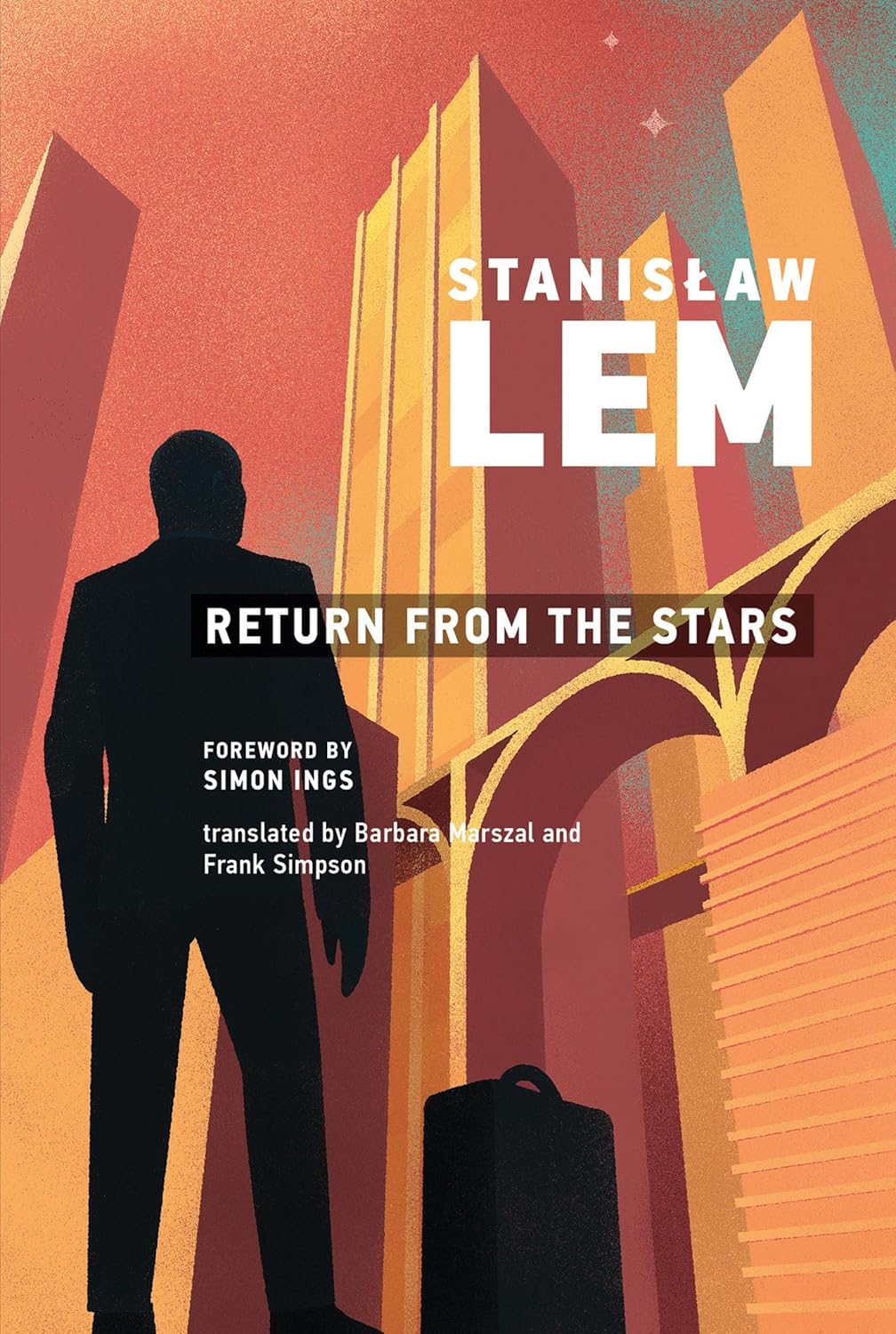
The Return of the Stars by author Stanisław Lem is a story about a man without a home. It is a story that resonates with many: while we are not astronauts in the literal sense of the protagonist Hal Bregg, all of us have begun an adventure and returned as very different people, and lost the ability to enjoy life in the same capacity. But one gains something equally unique: the singular capacity to see life through specifically forged lenses. In that sense we become, like Bregg, a version we chose, rather than the image the world usually demands.
In a process very similar to our own adolescence, Hal Bregg undergoes a personal transformation. It occurs during his singular mission that lasts more than one hundred years. He has the ability to survive so long because of intermittent hypersleep, but at an extreme cost: he cannot return to his family or his home. During that time, when he is awake, he studies mathematics and other scientific concepts. The consequence of the learning is that Bregg becomes a very different person.
When he returns to Earth, it is a very different place — to the point that he cannot understand it. The people are strange, with incomprehensible technology. He attempts to use his outdated skills in this "future" but nothing he has learned means anything, until he encounters a woman who is attracted to his tall physique, which is now unusual. In other words, she is sexually drawn to the barbarism, though it frightens her.
Along the road of broken hearts, with many sexual failures, he discovers that the reason women are drawn to him is because they have been lobotomized and cannot commit violence or in truth offer any resistance — they cannot say no. This becomes a very profound philosophical theme: in a world where no woman can say no to sexual advances, what stops a man without this lobotomization? A mirror held up to many things our culture takes for granted — are our concepts of love, family, and community a manifestation of our innate desire, or truly the result of factors outside our control? And how do we quantify them?
This internal battle is exemplified in our confused protagonist when he encounters a newlywed couple in a shared house in the countryside. When the husband needs to visit the city for two days for work, Bregg takes advantage of the situation. In the pool — bear in mind the woman cannot say no — Bregg kisses her and then follows her to her bedroom. When Bregg draws her away from the husband's power, he wrestles with his conscience — this is wrong.
The question that stays with the reader is somewhat different: is evil innate, or is it possibly our distorted conception? Because we exist in a society that dictates our behavior. Who is to say what is correct? Bregg returns to the mountains to find the answer. We see our own metaphorical mountains: our digital network and our separated communities. When we travel through history in our books, do we not feel that disconnection between the past and the present? Morality is decided by the moment. I choose to live in a moment of my own decision. And you?
Comments to the editor are welcome: thedeidaily@gmail.com